home / devices / multiple pendulum
Multiple Pendulum
A chain of one to ten pendulums moving according to real physics — gravity, rod length, stiffness, friction — used to drive sound. It began as a study patch in Pure Data, written to be read and taken apart, and grew into a Max for Live device.
→ 01 the Pure Data study (free download) → 02 the Max for Live device
01 — origin: a Pure Data study
It started as a double pendulum patched in Pure Data vanilla. A double pendulum is one of the simplest physical systems that behaves chaotically: start it twice from almost the same position and after a few seconds the two runs have nothing in common. The study then grew into a chain of up to ten rods that can be added or removed while it is moving, with an example sonification in which each mass is a sine voice — pitch from its height, loudness from its speed, stereo position from its horizontal position.
The patch was conceived as a teaching tool, so it is written to be read: every section is commented. Instead of solving an N×N system of equations, each mass first moves freely under gravity for a tiny time step and each rod then pulls its two ends back to the right length — Verlet integration with distance constraints — while a once-per-frame correction measures and restores the total energy. Along the way the comments explain the Pd techniques the physics relies on: shared state through [value], [table] and [expr], the right-to-left order of [trigger], loops that run in zero time with [until], [send]/[receive] used as function calls, and ten identical voices made with [clone] and summed on a [throw~]/[catch~] bus.
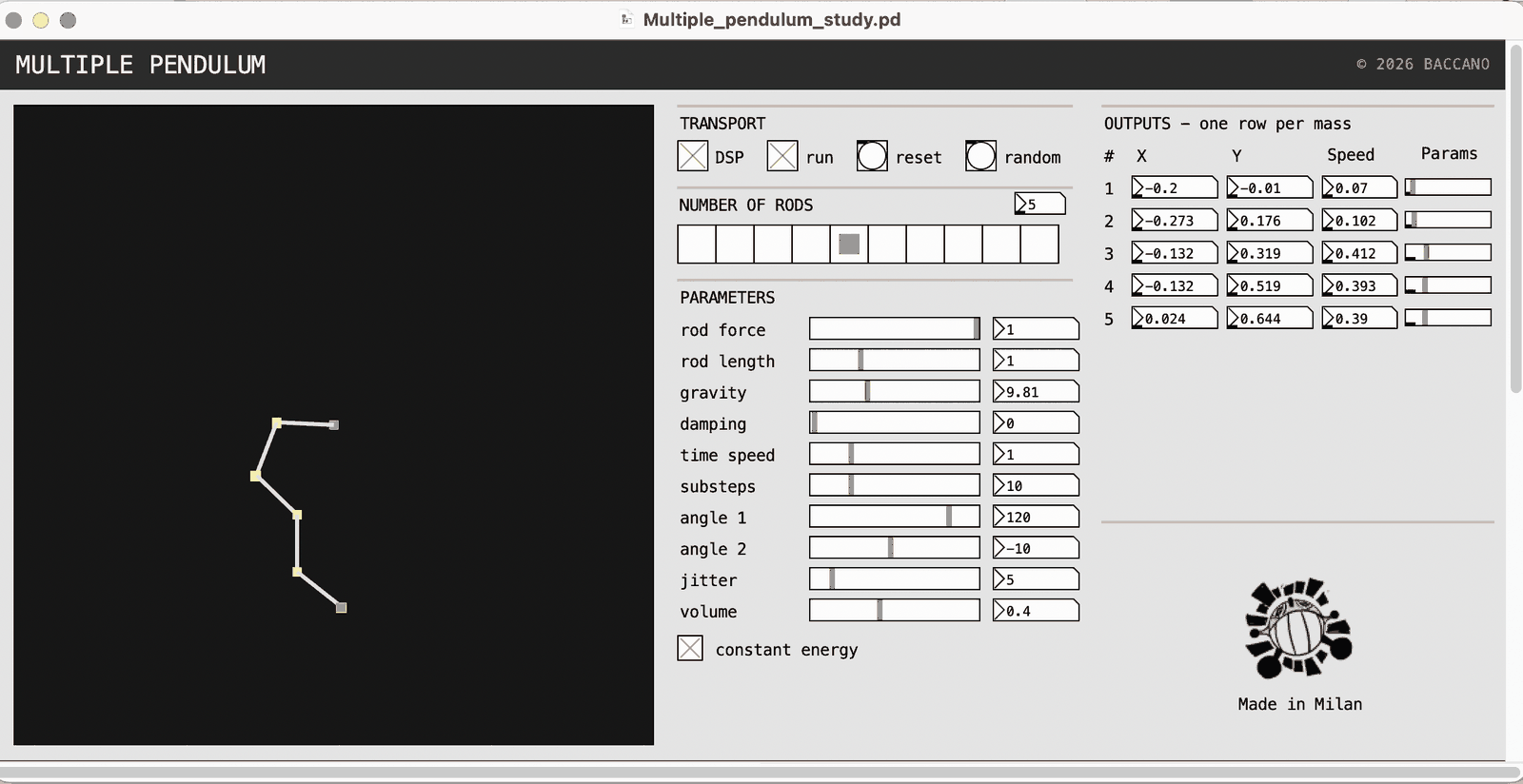
downloadMultiple_Pendulum_Study.zip — free, 35 KB
needsPure Data vanilla — ELSE required
contentsMultiple_pendulum_study.pd, pm-voice.pd (one voice, cloned ten times)
outputsevery mass sent as [r pm-mass] — use it for your own sonification
02 — result: the Max for Live device
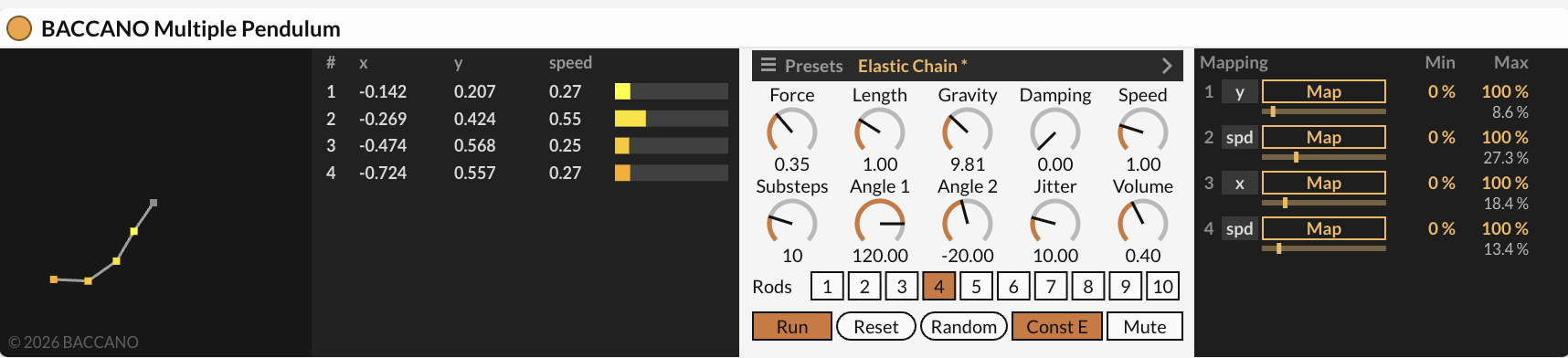
I kept using the chain to drive sounds, so I turned it into a device: the same physics running inside Ableton Live, with every mass able to move a parameter on the track.
→ get it on Gumroad (from €12, pay what you want)
a modulator that isn’t an LFO
The motion is neither regular nor random. An LFO repeats; a random generator has no memory. A pendulum chain is continuous, has inertia, speeds up and slows down, and all its masses are connected — so whatever they control moves together in a way that feels physical. It works well on filters, sends, panning, grain positions: anything that benefits from movement that breathes instead of ticking.
mapping
A mapping column has one row per mass. For each row you choose what drives it — horizontal position, height or speed of that mass — then press Map and click any parameter on the same track, mixer included, with a Min/Max range.
formatMax for Live audio effect (.amxd)
needsLive 11 or later, Suite or Standard with Max for Live
systemsmacOS (Apple Silicon and Intel), Windows 10 and 11
presets8 factory presets, user presets saved with the Live set
licensepersonal key, up to 5 computers
includesthe device (.amxd) and a PDF user manual
byBACCANO, 2026